 FREE shipping on orders over US$200
What Is an Optical Circulator?
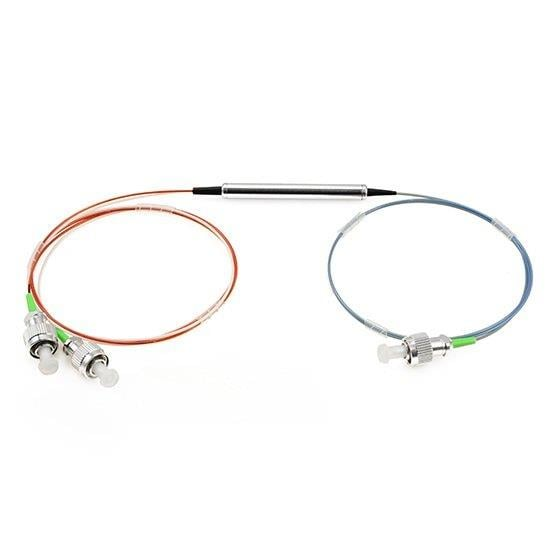
An Optical Circulator is a non-reciprocal passive device used in fiber optic communication systems to control the direction of light propagation. Unlike optical isolators that block reflected light, a circulator routes optical signals in a specific order — typically Port 1 → Port 2 and Port 2 → Port 3 — while preventing unwanted back reflections.
In simple terms, it works like a one-way traffic system for light: the signal enters one port and exits another, ensuring clean, unidirectional transmission.
How Does an Optical Circulator Work?
Optical circulators operate based on Faraday rotation and polarization control. Inside the device, a magneto-optic crystal (commonly TGG – Terbium Gallium Garnet) and polarizing components manipulate the polarization of the light so that it only travels in a designated direction.
This non-reciprocal property ensures that light traveling backward is diverted to a different port instead of reflecting back into the source, protecting sensitive components such as lasers, EDFAs, or DWDM modules.
Key Features and Performance Parameters
Modern optical circulators — like those manufactured by Fiber-Life — are engineered with high-precision optical alignment and advanced coating technology to achieve excellent optical performance.
| Parameter | Typical Specification |
| Operating Wavelength | 1064 nm / 1310 nm / 1480 nm / 1550 nm / C+L Band (1528–1610 nm) |
| Port Configuration | 3 Ports (custom 4-port available) |
| Fiber Type | SMF-28e or PM1550 (PANDA) |
| Insertion Loss | ≤ 0.8 dB |
| Isolation | ≥ 40 dB |
| Return Loss | ≥ 50 dB |
| Power Handling | 300 mW – 2 W |
| Axis Alignment (PM Type) | Slow Axis Aligned to Key |
Types of Optical Circulators
1️⃣ Singlemode Optical Circulator (SM Type)
Used in standard communication systems, DWDM, and testing setups. Built with Corning SMF-28e fiber for low-loss operation.
2️⃣ Polarization Maintaining Optical Circulator (PM Type)
Uses PM1310 or PM1550 PANDA fiber to maintain the input polarization state. Essential for fiber lasers, interferometers, and coherent communication systems.
3️⃣ C+L Band Broadband Optical Circulator
Covers a wide wavelength range (1528 – 1610 nm) for DWDM, ROADM, and amplifier monitoring applications.
4️⃣ High-Power TGG Circulator
Employs a Terbium Gallium Garnet crystal to handle laser powers up to several watts — ideal for industrial and research lasers.
Common Applications
Optical circulators are critical components in both telecom and research applications.
- EDFA and Raman Amplifiers – for input/output signal separation
- DWDM & CWDM Systems – channel monitoring and bidirectional data flow
- OTDR Testing – separating transmitted and reflected signals
- Fiber Sensors – enabling interferometric and distributed sensing
- Fiber Lasers & PM Systems – maintaining polarization stability and preventing feedback
Why Choose Fiber-Life Optical Circulators?
At Fiber-Life.com, we specialize in designing and manufacturing high-precision optical components for advanced fiber-optic applications. Our circulators are characterized by:
- Low insertion loss and high isolation
- Excellent polarization extinction ratio (PER)
- Compact, reliable, and rugged design
- Available in 300 mW, 1000 mW, and 2000 mW power ratings
- Configurable axis options: Slow Axis, Fast Axis, or Both Axes
- Multiple fiber diameters available: 250 μm bare, 900 μm buffer, 2.0 mm, and 3.0 mm jacket
We offer customized versions for 1064 nm, 1310 nm, 1480 nm, 1550 nm, and C+L Band operation, all built with premium PM PANDA or SMF-28e fiber and tested under strict temperature control at 25 °C.
Final Thoughts
The optical circulator is a small but essential component in modern photonic systems. Whether used in fiber lasers, DWDM networks, or sensing applications, its ability to manage optical flow with precision and stability makes it indispensable.
If you are looking for high-reliability optical circulators, Fiber-Life provides both standard and customized solutions to meet your engineering and system-integration needs.
👉 Explore our full range of circulators and fiber-optic components at www.Fiber-Life.com