FREE shipping on orders over US$200
As data centers and enterprise networks continue to evolve toward higher density and higher bandwidth, MTP and MPO cables have become core components in modern optical cabling systems. Although the two terms are often used interchangeably, MTP and MPO cables are not the same, and choosing the wrong type can impact network reliability, scalability, and long-term performance.
This guide explains the real differences between MTP and MPO cables, how they affect network design, and how to choose the right solution for your application.
MTP vs. MPO: Quick Comparison
| Aspect | MPO Cable | MTP Cable |
|---|---|---|
| Connector Type | Standardized interface | Enhanced MPO (proprietary) |
| Standard | IEC 61754-7 / TIA-604-5 | US Conec (Corning) design |
| Compatibility | Industry-wide | Fully backward-compatible with MPO |
| Alignment & Tolerance | Standard tolerance | Tighter alignment control |
| Mating Durability | Standard cycles | Up to 1,000 mating cycles |
| Performance Consistency | Varies by manufacturer | Highly consistent |
| Customization | Limited | Extensive |
| Typical Use | Cost-sensitive deployments | Mission-critical networks |
In short: MPO focuses on standardization and cost efficiency, while MTP focuses on performance stability and long-term reliability.
What Is an MPO Cable?
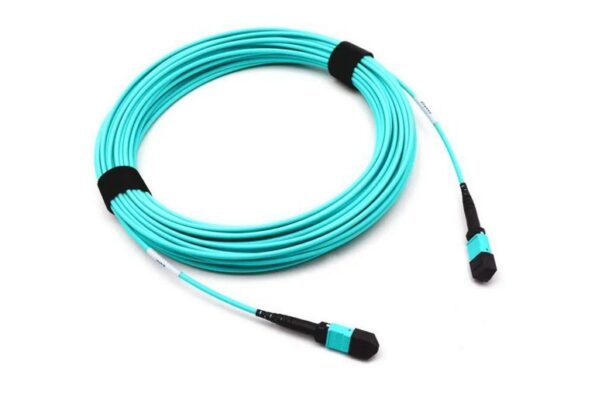
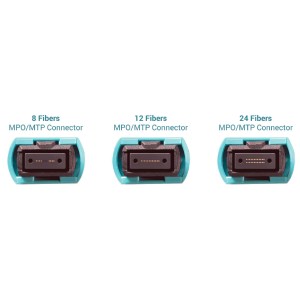
MPO (Multi-Fiber Push-On) is a standardized multi-fiber optical connector defined by IEC and TIA. An MPO connector integrates multiple fibers—commonly 8, 12, 24, or 48 fibers—into a single compact interface, enabling high-density connectivity and fast deployment.
MPO cables support both singlemode and multimode fibers, including OM1 through OM5, and are widely used in:
- Data center cabling
- Enterprise networks
- Telecommunications infrastructure
Because MPO is an open standard, connectors from different manufacturers are interoperable, making MPO cables a practical choice for budget-sensitive or standardized environments.
What Is an MTP Cable?
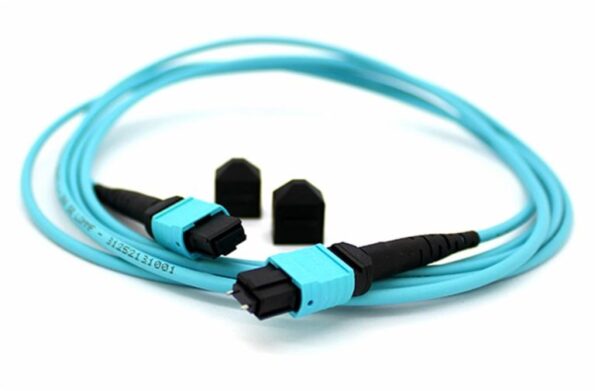
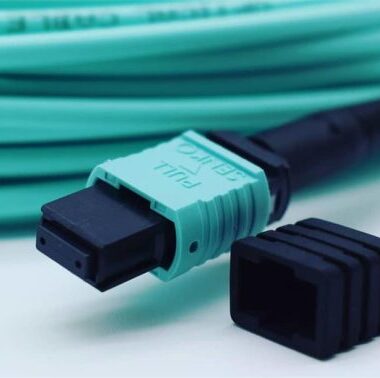
MTP (Multi-Fiber Termination Push-On) is an enhanced version of the MPO connector developed by US Conec (Corning). While MTP connectors fully comply with MPO mating interfaces, they incorporate design improvements to address alignment precision, durability, and signal consistency.
Key enhancements include:
- Precision-engineered guide pins
- Improved ferrule design for fiber alignment
- Reinforced connector housing
- Higher mating-cycle durability
These improvements result in lower and more consistent insertion loss, making MTP cables better suited for high-density, high-performance networks.
Key Differences That Matter in Real Networks
1. Standardization vs. Optimization
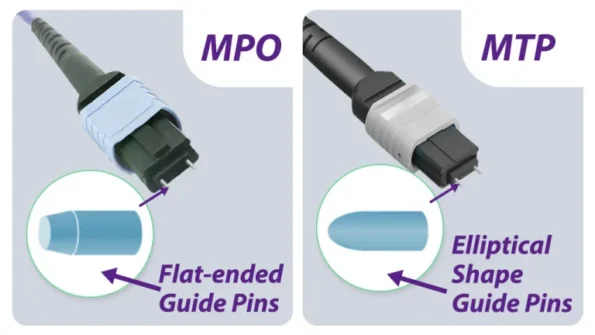
MPO connectors strictly follow published standards, ensuring broad compatibility but limiting design flexibility.
MTP connectors, while MPO-compatible, are optimized through proprietary engineering, allowing tighter tolerances and continuous refinement.
Result: MPO prioritizes interoperability; MTP prioritizes performance consistency.
2. Performance Stability
In large-scale deployments, small variations in insertion loss can accumulate and affect link budgets.
MTP cables are manufactured with tighter tolerances and typically undergo 100% optical testing, reducing performance variation between connections.
This makes MTP a preferred choice for:
- 40G / 100G / 400G networks
- Spine-leaf data center architectures
- Long-term backbone cabling
3. Durability and Lifecycle
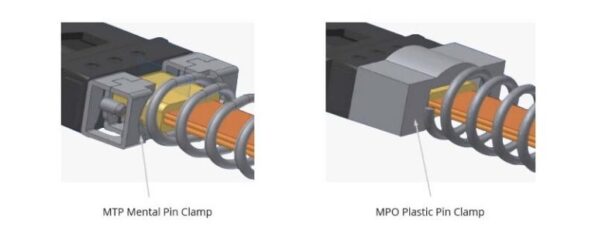
Repeated mating and reconfiguration are common in modern data centers.
MTP connectors are designed to withstand significantly more mating cycles than standard MPO connectors, reducing long-term maintenance risk.
4. Customization Flexibility
Standard MPO cables are often limited to fixed configurations.
MTP cables offer greater flexibility, including:
- Fiber counts from 8 up to high-density configurations
- Polarity options (Type A, B, C)
- Trunk and breakout designs
- Jacket options such as LSZH, PVC, or plenum-rated
This flexibility is critical for complex or evolving network designs.
Typical Application Scenarios
When MPO Cables Make Sense
MPO cables are well suited for:
- Cost-sensitive deployments
- Standard enterprise networks
- Short-term or temporary installations
- Legacy MPO infrastructure expansion
If interoperability and upfront cost are the main priorities, MPO is often sufficient.
When MTP Cables Are the Better Choice
MTP cables are preferred for:
- Hyperscale and cloud data centers
- High-density backbone cabling
- Mission-critical networks
- Environments requiring long-term stability and scalability
In these cases, performance consistency and durability outweigh initial cost considerations.
How to Choose Between MTP and MPO
When deciding between MTP and MPO cables, focus on three key factors:
- Reliability Requirements
Mission-critical links benefit from MTP’s tighter tolerances. - Scalability Needs
High fiber counts and future upgrades favor MTP solutions. - Budget Constraints
Standard MPO cables are suitable for controlled, cost-driven environments.
Conclusion
MTP vs. MPO is not a matter of “better or worse,” but choosing the right tool for the right application.
- MPO cables provide standardized, cost-effective connectivity for many traditional network environments.
- MTP cables deliver enhanced performance, durability, and customization for high-density and mission-critical systems.
Understanding these differences allows network designers to build optical infrastructures that balance performance, cost, and long-term flexibility—ensuring reliable operation as bandwidth demands continue to grow.