 FREE shipping on orders over US$200
Fiber optic pigtails play a critical role in modern optical networks, serving as the interface between optical fibers and active or passive devices through fusion splicing. Among the various options available, singlemode fiber pigtails and multimode fiber pigtails are the two most widely used types.
Although they may appear similar at first glance, singlemode and multimode fiber pigtails differ significantly in fiber structure, transmission performance, cost, and application suitability. Choosing the wrong type can lead to unnecessary signal loss, limited scalability, or higher network costs.
This guide provides a practical, engineering-oriented comparison to help you select the right fiber pigtail for your specific application.
Singlemode vs Multimode Fiber Pigtails at a Glance
| Parameter | Singlemode Fiber Pigtail | Multimode Fiber Pigtail |
|---|---|---|
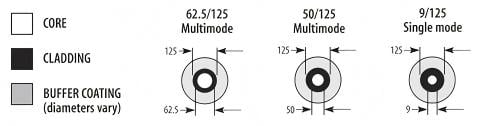
| Core / Cladding | 9/125 μm | 50/125 μm, 62.5/125 μm |
| Supported Wavelengths | 1310 nm, 1550 nm | 850 nm, 1300 nm |
| Transmission Distance | 10 km – 100 km+ | Typically ≤ 2 km |
| Attenuation | Very low | Higher |
| Bandwidth Capability | Extremely high | High (short distance) |
| Typical Cost | Higher | Lower |
| Common Use | Long-haul, backbone, FTTH | LAN, data centers, industrial networks |
Core Differences: Fiber Structure and Signal Transmission
Singlemode Fiber Pigtails
Singlemode fiber pigtails feature a 9 μm core, allowing only a single light mode to propagate. This minimizes modal dispersion and enables light to travel in a nearly straight path, resulting in excellent signal integrity over long distances.
They typically operate at 1310 nm and 1550 nm, where fiber attenuation is lowest—making them ideal for long-distance and high-bandwidth transmission.
Key advantages:
- Extremely low attenuation
- Long transmission reach
- Excellent performance for high-speed and coherent systems
Multimode Fiber Pigtails
Multimode fiber pigtails have a larger core—50 μm or 62.5 μm—which allows multiple light modes to propagate simultaneously. While this simplifies coupling and reduces transceiver cost, it also introduces modal dispersion, limiting transmission distance.
Multimode pigtails typically operate at 850 nm or 1300 nm and are optimized for short-range connectivity.
Key advantages:
- Lower overall system cost
- Easier alignment
- Well-suited for short-distance, high-density environments
Performance Considerations That Matter in Real Networks
Attenuation and Transmission Distance
For long-distance links, attenuation is often the deciding factor. Singlemode fiber pigtails exhibit significantly lower attenuation—approximately 0.36 dB/km at 1310 nm and 0.22 dB/km at 1550 nm—allowing transmission over tens of kilometers without amplification.
Multimode fiber pigtails, affected by modal dispersion, are typically limited to hundreds of meters to a few kilometers, depending on fiber grade (OM1–OM5) and data rate.
Insertion Loss and Return Loss
High-quality fiber pigtails are factory-terminated and polished to ensure consistent performance. Typical specifications include:
- Insertion Loss: ≤ 0.25 dB
- Return Loss:
- Singlemode: ≥ 50 dB
- Multimode: ≥ 35 dB
In high-speed or long-haul networks, better return loss performance helps reduce back reflections and maintain signal stability.
Environmental Reliability
Both singlemode and multimode fiber pigtails are available in standard, armored, and waterproof designs, supporting harsh environments such as outdoor installations or industrial sites.
Typical operating temperature ranges:
- Operating: -40°C to +75°C
- Storage: -45°C to +85°C
Environmental durability is usually determined by cable construction rather than fiber type, meaning the choice between singlemode and multimode should focus primarily on transmission requirements.
Application Scenarios
When to Choose Singlemode Fiber Pigtails
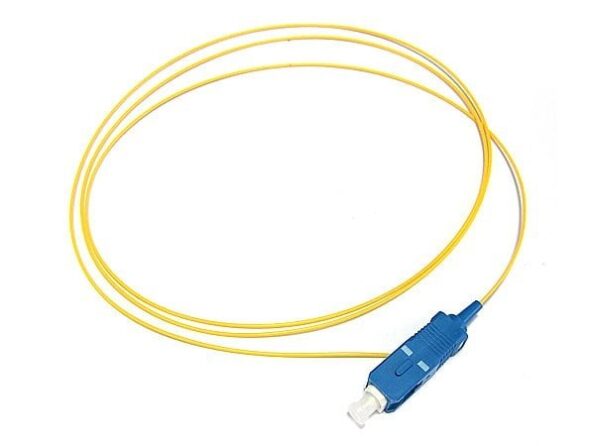
Singlemode fiber pigtails are the preferred solution for applications where distance, bandwidth, and signal integrity are critical:
- Telecommunication backbones
- FTTH and access networks
- Inter-building or campus links
- High-speed data centers (long interconnects)
If your network extends beyond a few kilometers or must support future bandwidth upgrades, singlemode pigtails are often the only practical choice.
When to Choose Multimode Fiber Pigtails
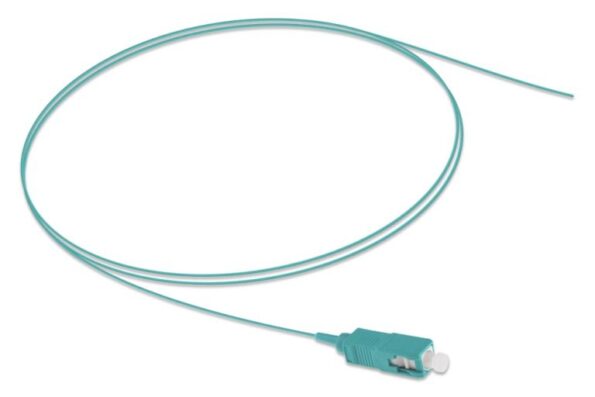
Multimode fiber pigtails are ideal for cost-sensitive, short-distance applications:
- Local Area Networks (LANs)
- Intra-data-center connections
- Industrial control systems
- Short-reach server and switch interconnects
OM3 and OM4 multimode pigtails, for example, are widely used for 10G to 100G Ethernet over distances up to 300 m (OM3) and 550 m (OM4).
Step-by-Step Guide to Selecting the Right Fiber Pigtail
Step 1: Define Transmission Distance
If your link exceeds 2 km, singlemode is the clear choice.
Step 2: Evaluate Bandwidth Needs
High-speed and future-proof networks favor singlemode; short-range high-density networks may benefit from multimode.
Step 3: Check Connector Compatibility
Both fiber types are available with LC, SC, FC, and ST connectors—ensure compatibility with your equipment.
Step 4: Consider Installation Environment
Outdoor or industrial deployments may require armored or waterproof pigtails.
Step 5: Balance Cost and Performance
Multimode reduces upfront cost for short distances, while singlemode offers superior scalability and longevity.
Why Fiber Pigtails Matter
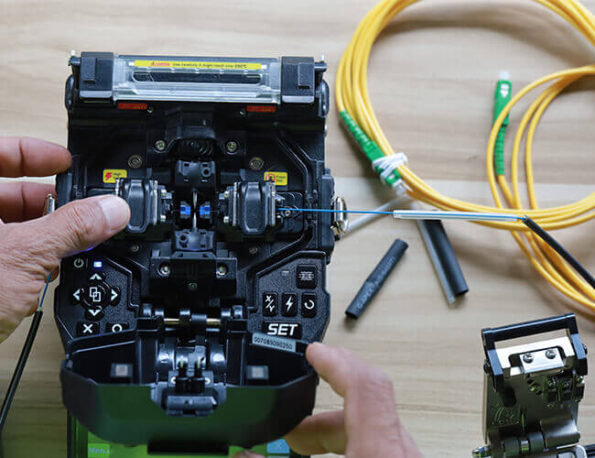
Fiber pigtails are more than just short fiber assemblies—they form the foundation of fusion spliced links. Factory-terminated pigtails provide consistent end-face quality, low insertion loss, and reliable long-term performance, reducing installation time and minimizing field errors.
Selecting the correct fiber pigtail ensures not only immediate network performance but also long-term stability and upgrade flexibility.
Conclusion
Singlemode and multimode fiber pigtails each serve distinct roles in optical networks. Singlemode pigtails excel in long-distance, high-bandwidth applications, while multimode pigtails offer a cost-effective solution for short-range connectivity.
By understanding their structural differences, performance characteristics, and application suitability, you can confidently choose the right fiber pigtail to optimize your network’s performance, reliability, and total cost of ownership.