 FREE shipping on orders over US$200
In fiber optic communication systems, optical signal power must be carefully controlled to ensure stable transmission and reliable receiver performance. When signal levels are too high—especially in short-distance or high-power links—signal distortion, bit errors, or even receiver damage can occur.
An SC fiber optic attenuator is a simple yet essential passive component designed to reduce optical signal power to a controlled level. It is widely used in telecommunications networks, data centers, FTTH systems, and optical testing environments.
This article explains what an SC attenuator is, the different types available, where and when to use it, and how to choose the right SC attenuator for your application.
What Is an SC Fiber Optic Attenuator?
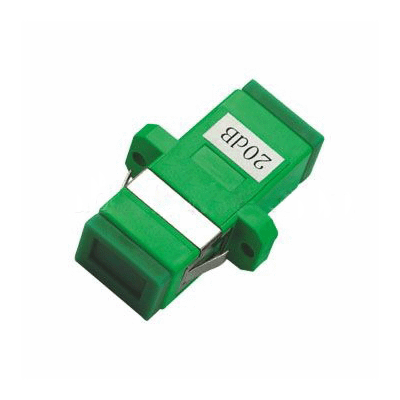
An SC attenuator is a passive optical device that reduces signal power in a fiber optic link while maintaining signal integrity. It uses an SC connector interface and is typically installed directly onto a fiber port, adapter, or patch cord.
SC attenuators are commonly used to:
- Prevent receiver overload
- Simulate link loss during testing
- Balance optical power levels in networks
They are compatible with singlemode and multimode fibers and are available in various attenuation values to meet different system requirements.
When Do You Need an SC Attenuator?
SC attenuators are commonly required in the following scenarios:
1. Receiver Overload Protection
In short-distance links or systems using high-power transmitters, the received optical power may exceed the receiver’s tolerance. An SC attenuator reduces signal strength to a safe operating range.
2. Optical Network Testing and Calibration
During installation, troubleshooting, or laboratory testing, attenuators are used to simulate real-world link loss and verify system margins.
3. Power Balancing in Optical Networks
In FTTH, CATV, or PON networks, optical power levels may vary between channels. Attenuators help equalize signal levels for consistent performance.
Common Types of SC Attenuators
Fixed vs. Variable SC Attenuators
- Provide a predefined attenuation value
- Common values: 1, 3, 5, 10, 15, 20 dB
- Stable, compact, and maintenance-free
- Ideal for permanent installations
Variable SC Attenuators
- Adjustable attenuation over a range
- Useful for testing and temporary setups
- Typically used in labs or commissioning stages
SC/UPC vs. SC/APC Attenuators
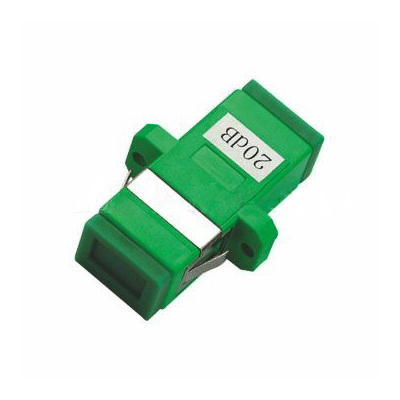
- SC/UPC Attenuator
- Flat-polished end face
- Return loss typically ≥ 50 dB
- Used in most data center and telecom systems
- SC/APC Attenuator
- 8-degree angled end face
- Return loss typically ≥ 60 dB
- Preferred in CATV, FTTH, and high-reflection-sensitive applications
SC/UPC and SC/APC must not be mixed in the same connection.
Male–Female vs. Female–Female SC Attenuators
- Male–Female (Plug-Type)
- Installed directly onto a transceiver or device port
- Compact and commonly used
- Female–Female (Bulkhead-Type)
- Installed between two patch cords
- Often used in patch panels or distribution frames
Typical Performance Specifications
High-quality SC attenuators typically offer:
- Attenuation accuracy: ±0.5 dB
- Insertion loss: ≤ 0.2 dB (excluding attenuation value)
- Return loss:
- SC/UPC ≥ 50 dB
- SC/APC ≥ 60 dB
- Operating temperature: -40°C to +75°C
Stable performance over time is critical, especially in permanent network deployments.
How to Choose the Right SC Attenuator
When selecting an SC attenuator, consider the following factors:
Step 1: Identify Required Attenuation Value
Measure transmitter output power and receiver sensitivity to determine how much signal reduction is needed.
Step 2: Match Connector Type
Choose SC/UPC or SC/APC based on existing network interfaces—never mix the two.
Step 3: Determine Installation Method
Select male–female for direct port installation or female–female for patch panel use.
Step 4: Consider Application Environment
For permanent installations, fixed attenuators are recommended. Variable attenuators are better suited for testing and temporary setups.
Typical Applications of SC Attenuators
SC attenuators are widely used in:
- Telecommunication networks
- Data centers
- FTTH and CATV systems
- Optical test and measurement environments
Their simplicity and reliability make them an indispensable tool in modern fiber optic systems.
Conclusion
An SC fiber optic attenuator is a small but critical component for maintaining proper optical power levels in fiber networks. By preventing receiver overload, enabling accurate testing, and balancing signal strength, SC attenuators help ensure stable, error-free communication.
Understanding attenuator types, connector options, and application requirements allows network engineers to select the right solution for both current performance and long-term reliability.