 FREE shipping on orders over US$200
1. What Is an In-Line Variable Optical Attenuator?
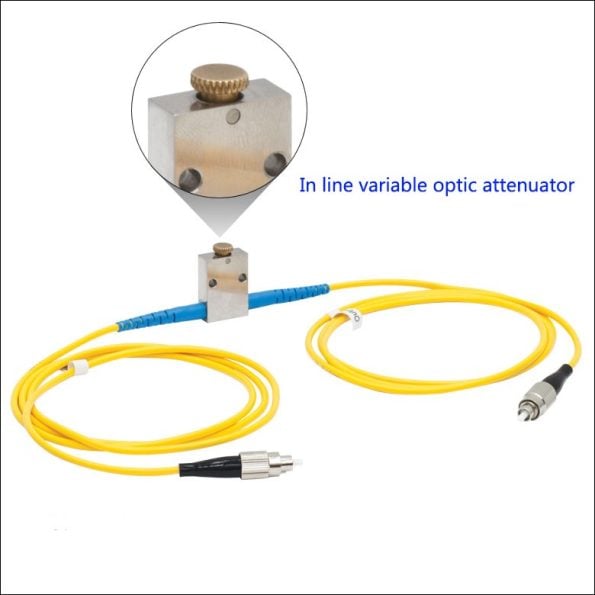
In-line variable optical attenuators (VOAs) are essential passive components in modern fiber optic communication systems. They are designed to precisely control optical signal power without interrupting the transmission path. By fine-tuning the signal level, VOAs help maintain the optimal performance of optical amplifiers, receivers, and wavelength-division multiplexing (WDM) systems.
Unlike fixed attenuators that offer a constant attenuation level, variable optical attenuators allow users to adjust the power dynamically—either manually or electronically—depending on the network conditions and testing requirements.
2. How Does an In-Line VOA Work?
The principle behind an in-line VOA lies in controlling the amount of light that passes through the optical fiber. Depending on the design, this can be achieved through:
- Mechanical adjustment (changing the fiber gap or angle),
- Micro-Electro-Mechanical Systems (MEMS) technology (using micro mirrors to deflect light), or
- Electro-optic methods (using voltage to alter refractive properties).
At Fiber-Life, our VOAs adopt high-precision mechanical tuning structures, ensuring low insertion loss, excellent repeatability, and superior return loss performance for both single-mode and multimode fibers.
3. Why Is VOA Important in Optical Networks?
As optical networks scale up in capacity and complexity, maintaining uniform optical power levels becomes critical. Overloaded receivers or amplifiers can cause distortion, while weak signals increase bit error rates.
VOAs solve this by:
- Balancing optical power across DWDM channels,
- Simulating optical loss in testing environments,
- Protecting receivers from high optical input,
- Controlling gain in EDFA and Raman amplifier systems.
For instance, in a C-band DWDM system, a VOA can equalize power among channels after multiplexing, ensuring system stability and long-term reliability.
4. Key Performance Parameters
When choosing a VOA, engineers should focus on several technical specifications:
- Attenuation Range: Typically 0–60 dB
- Resolution: 0.1–0.5 dB
- Insertion Loss: ≤ 0.8 dB (for high-quality models)
- Return Loss: ≥ 55 dB
- Operating Wavelength: 1260–1650 nm
- Connector Type: FC/SC/LC/ST, UPC/APC optional
- Fiber Type: Singlemode or Multimode
These parameters define not only the precision but also the stability of the device under varying environmental conditions.
5. Fiber-Life In-Line VOA — Reliable, Customizable, and Cost-Effective
At Fiber-Life (https://fiber-life.com), we provide a full range of In-Line Variable Optical Attenuators that meet international telecom and laboratory standards.
Our VOA products feature:
- Low insertion loss and high stability over wide temperature ranges
- Compact and rugged design for easy integration into network systems
- Customizable connectors and cable lengths (LC/SC/FC/ST, UPC/APC, 0.25m–2m)
- Optional wavelength range for 1310 nm, 1490 nm, and 1550 nm
- High repeatability suitable for DWDM, EDFA, and optical testing applications
Whether you need a manual adjustable VOA for lab use or a fixed attenuation setup for production lines, our engineering team can tailor solutions according to your requirements.
6. Conclusion
In-line variable optical attenuators are vital to ensuring precision and power balance in optical communication systems.
By integrating a reliable VOA solution from Fiber-Life, you can enhance network performance, reduce error rates, and achieve superior control over your optical links.