FREE shipping on orders over US$200
Multimode fiber is the preferred choice for short-distance data transmission, widely deployed across campus networks, enterprise LANs, and data centers. With several types available—OM1, OM2, OM3, OM4, and OM5—each offering distinct performance characteristics, selecting the right fiber can be challenging. This guide breaks down the key differences between these multimode fibers to help you make an informed decision.
Multimode Fiber Types and Their Key Differences
Unlike single-mode fiber, multimode fiber features a larger core diameter—typically 50μm or 62.5μm—enabling the propagation of multiple light modes. Classified under the ISO 11810 standard, multimode fibers are categorized into OM1 through OM5, each designed to meet specific bandwidth and distance requirements.
- OM1 Fiber
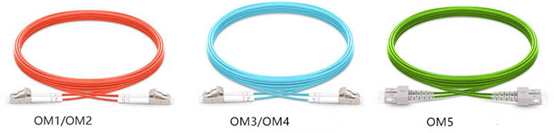
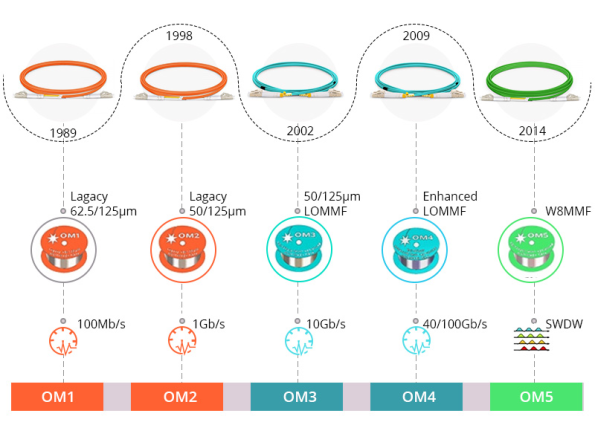
Characterized by a 62.5μm core and orange jacket, OM1 uses an LED light source and supports bandwidths of 200/500 MHz·km at 850/1300 nm. It is commonly used in Ethernet applications up to 1 Gbps and offers excellent light-gathering capability and bend resistance. - OM2 Fiber
With a 50μm core and orange sheath, OM2 also uses LED illumination but provides a higher bandwidth of 500/500 MHz·km. It is suitable for Gigabit Ethernet and offers improved modal dispersion control and lower production costs compared to OM1. - OM3 Fiber
OM3 is a laser-optimized multimode fiber (LOMMF) with a 50μm core and aqua blue jacket. It uses an 850 nm VCSEL laser source, supports bandwidth up to 2000 MHz·km, and is ideal for 10 Gigabit Ethernet, with support for distances up to 300 meters. - OM4 Fiber
As an enhanced version of OM3, OM4 retains the 50μm core and aqua blue jacket but doubles the effective bandwidth to 4700 MHz·km. It supports 10, 40, and 100 Gigabit Ethernet with transmission distances up to 400 meters at 10 Gbps. - OM5 Fiber
The latest in multimode fiber, OM5 features a lime green jacket and the same 50μm core. It supports shortwave wavelength division multiplexing (SWDM) and offers a bandwidth of 28,000 MHz·km, enabling higher data rates over fewer fibers for 40/100/400G applications.
Physical and Performance Comparison
1. Physical Specifications
| Fiber Type | Core/Cladding (µm) | Jacket Color | Light Source | Bandwidth (MHz·km) |
|---|---|---|---|---|
| OM1 | 62.5/125 | Orange | LED | 200 |
| OM2 | 50/125 | Orange | LED | 500 |
| OM3 | 50/125 | Aqua Blue | VCSEL | 2000 |
| OM4 | 50/125 | Aqua Blue | VCSEL | 4700 |
| OM5 | 50/125 | Lime Green | VCSEL | 28000 |
2. Supported Transmission Distances (in meters)
| Fiber Type | Fast Ethernet | 1GbE | 10GbE | 40GbE | 100GbE |
|---|---|---|---|---|---|
| OM1 | 2000 | 275 | 33 | – | – |
| OM2 | 2000 | 550 | 82 | – | – |
| OM3 | 2000 | 550 | 300 | 100 | 100 |
| OM4 | 2000 | 550 | 550 | 150 | 150 |
| OM5 | – | – | 550 | 440 | 150 |
Evolution and Applications of Multimode Fiber
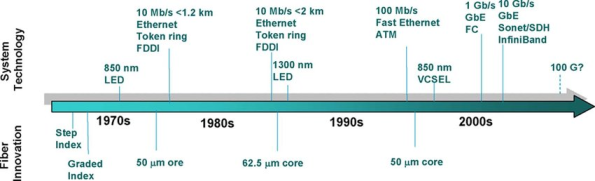
Driven by growing demands for higher speed and bandwidth, multimode fiber continues to evolve toward lower loss, higher bandwidth, and multi-wavelength operation. From early deployments of OM1 and OM2 in 1G networks to the widespread use of OM3 and OM4 in today’s 10G/40G data centers, multimode technology has consistently delivered cost-effective performance.
OM5 represents the next step, supporting 40G/100G/400G Ethernet with reduced fiber count and power consumption. It is poised to become the fiber of choice for next-generation hyperscale data centers.
Frequently Asked Questions About Multimode Fiber
1. Multimode vs. Single-Mode Fiber: What’s the Difference?
- Core Diameter: Multimode: 50/62.5 µm; Single-mode: 9 µm
- Bandwidth: Single-mode offers higher bandwidth (up to 100,000 GHz)
- Light Source: Multimode often uses LED/VCSEL; Single-mode uses lasers
- Distance: Multimode is suited for short-reach applications (up to 550m)
- Cost: Multimode systems are generally more affordable
2. Common Multimode Fiber Connector Types
Popular multimode fiber connectors include ST, SC, FC, LC, and MTP/MPO. The table below highlights key differences:
| Connector | Ferrule Size1 | Insertion Loss | Typical Cost |
|---|---|---|---|
| SC | φ2.5mm | 0.25–0.5 dB | $1.00 |
| LC | φ1.25mm | 0.25–0.5 dB | $1.20 |
| FC | φ2.5mm | 0.25–0.5 dB | $1.00 |
| ST | φ2.5mm | 0.25–0.5 dB | $1.00 |
| MTP/MPO | φ2.5mm | 0.25–0.5 dB | Varies |
- The ferrule—typically ceramic, metal, or plastic—ensures precise fiber alignment. ↩︎
3. Key Advantages of Multimode Fiber
- High-Capacity, Interference-Free Transmission: Supports multiple simultaneous data streams with minimal loss and no cross-talk.
- Multi-Protocol Support: Compatible with Ethernet, InfiniBand, and Internet Protocol, making it ideal for core network applications.
- Cost Efficiency: Lower installation and maintenance costs compared to single-mode solutions.
4. Can Multimode Fiber Be Used as Single-Mode?
No. Due to higher modal dispersion and attenuation, multimode fiber is not suitable for long-haul transmission.
Conclusion
Multimode fiber remains a reliable, high-capacity, and cost-effective solution for in-building backbone and data center applications—especially for links under 600 meters. While it cannot replace single-mode fiber in long-distance scenarios, its versatility and economy make it ideal for many enterprise and data center environments.
When choosing between single-mode and multimode, consider your application requirements, transmission distance, and budget to determine the best fit.