FREE shipping on orders over US$200
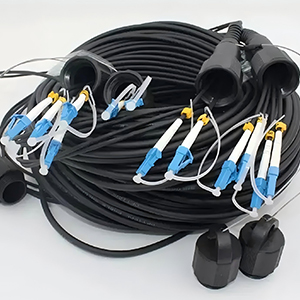
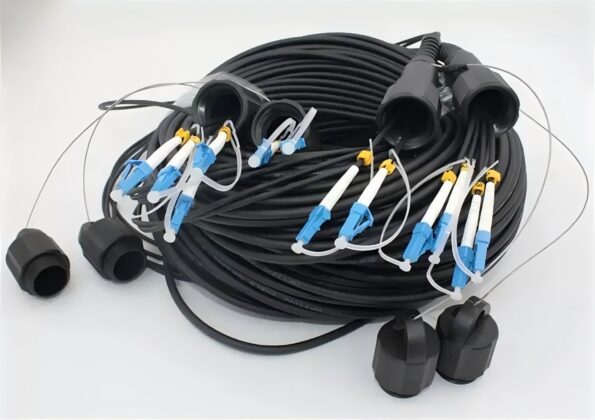
Industrial Armored TPU Fiber Optic Patch Cables are purpose-built for reliable optical transmission in demanding industrial environments. As a specialized form of Industrial Cables, they combine armored protection, a durable TPU outer jacket, and stable fiber performance to support industrial communication where standard patch cords cannot operate safely or reliably. These cables are widely deployed in factories, manufacturing plants, power stations, mining sites, petrochemical facilities, and oil & gas applications where mechanical stress and environmental exposure are unavoidable.
Why Industrial Environments Require Armored TPU Fiber Optic Patch Cables
Industrial sites expose fiber connections to constant risks such as vibration, foot traffic, abrasion, oil contamination, and accidental impact. Conventional indoor fiber patch cords are not designed to withstand these conditions.
An Industrial Armored TPU Fiber Optic Patch Cable provides enhanced protection while maintaining optical stability. Its design allows fiber links to be installed in open industrial areas without additional conduit, making it a practical ruggedized fiber optic cable solution for complex and high-risk environments.
Key Structural Features of Industrial Armored TPU Fiber Optic Patch Cables
Armored Protection Layer
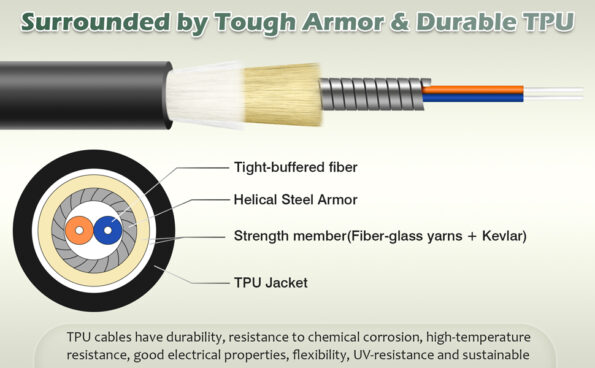
The armored layer, commonly made from stainless steel or similar materials, protects the fiber from crushing forces, rodent damage, and accidental mechanical impact. This structure significantly improves safety and reliability in industrial installations.
TPU Outer Jacket
The TPU (Thermoplastic Polyurethane) jacket offers excellent resistance to abrasion, oil, chemicals, and mechanical wear. Compared with PVC or LSZH jackets, TPU provides superior flexibility and durability, especially in harsh industrial environments with frequent movement or contact.
Optical Fiber Core
These patch cables support single-mode and multimode fiber options, enabling stable data transmission for industrial Ethernet, control systems, and optical communication networks. Despite their reinforced structure, optical performance remains consistent and reliable.
Together, these design elements place the cable firmly within the category of Specialty Fiber Cables designed for industrial-grade performance.
Typical Applications of Industrial Armored TPU Fiber Optic Patch Cables
Industrial Armored TPU Fiber Optic Patch Cables are commonly used in scenarios where both mechanical strength and signal reliability are critical:
- Factory automation systems connecting machines, sensors, and controllers
- Power plants and substations requiring EMI-resistant communication links
- Mining and heavy industrial sites exposed to vibration, dust, and physical stress
- Oil and gas facilities where chemical resistance and durability are essential
- Industrial cabinets, distribution frames, and control rooms with frequent cable handling
In these applications, the cable functions as a long-term component of industrial network infrastructure rather than a disposable connection.
How This Cable Fits into Industrial Cable Solutions
Industrial Cables are designed specifically for environments requiring durability, reliability, and application-specific features. Compared with standard fiber patch cords, Industrial Armored TPU Fiber Optic Patch Cables provide:
- Enhanced mechanical protection
- Greater resistance to environmental hazards
- Reduced risk of accidental damage
- Longer operational service life
For industrial communication systems, this type of armored fiber patch cord serves as a reliable complement to other industrial cable solutions, especially in high-risk or high-traffic areas.
Fiber-Life Industrial Armored TPU Fiber Optic Patch Cable Specifications
Fiber-Life Industrial Armored TPU Fiber Optic Patch Cables are designed for demanding industrial environments, offering flexible configuration options to meet different network and installation requirements.
- Fiber Counts: 1–24 fibers
- Multimode Fibers:
OM1 / OM2、OM3、OM4 - Multimode Connectors:
LC / SC / ST / FC / IP67 / ODC / YZC - Single Mode Fiber:
OS2 - Single Mode Connectors:
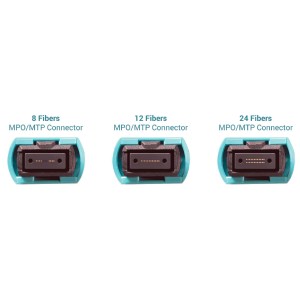
LC / SC / ST / FC / E2000 / MTP / IP67 / ODC / YZC
With support for multiple fiber types and rugged connector options, these cables provide a reliable ruggedized fiber optic cable solution and fit well within the Specialty Fiber Cables category for industrial communication systems.
Key Factors to Consider When Selecting an Industrial Armored TPU Fiber Optic Patch Cable
When selecting an Industrial Armored TPU Fiber Optic Patch Cable, several practical considerations should guide the decision:
- Installation environment: indoor, outdoor, or exposed industrial locations
- Mechanical risk level: vibration, foot traffic, bending, or potential impact
- Jacket material requirements: resistance to oil, chemicals, and abrasion
- Fiber and connector configuration: single-mode or multimode, LC/SC/FC options
- Expected service life: long-term operation under continuous industrial use
Matching these factors to the application ensures stable performance and reduced maintenance over time.
Maintenance and Durability Advantages
One of the key advantages of Industrial Armored TPU Fiber Optic Patch Cables is their low maintenance demand. The armored structure and TPU jacket minimize the risk of damage during installation and daily operation.
Recommended best practices include:
- Avoiding excessive bending beyond the minimum bend radius
- Performing routine visual inspections of jackets and connectors
- Keeping connection points clean in dusty or oily environments
With proper installation and basic maintenance, these cables deliver consistent optical performance over extended service periods.
Conclusion
Industrial Armored TPU Fiber Optic Patch Cables are engineered to meet the challenges of modern industrial environments where standard fiber patch cords are not sufficient. By combining armored protection, a robust TPU jacket, and reliable optical performance, they offer a dependable solution within the broader Industrial Cables ecosystem.
As industrial networks continue to evolve toward higher reliability and durability standards, this type of ruggedized fiber optic cable and Specialty Fiber Cable plays an increasingly important role in ensuring stable, long-term industrial communication.