FREE shipping on orders over US$200
Imagine waking up in Nairobi, selling stock in New York, streaming a 4-K lecture in Seoul, and having an AI colonoscopy in Zurich—all before lunch. The invisible thread stitching these experiences together is not code or capital, but light racing inside hair-thin glass. Fiber optic cables carry 99 % of the world’s international data and move photons 2 × 10⁸ m/s—fast enough to circle Earth five times in one second. Yet most users treat them like plumbing: essential, but boring. Let’s change that.
1. Anatomy of a Light Pipe
A single fiber is a three-layer nano-precision waveguide:
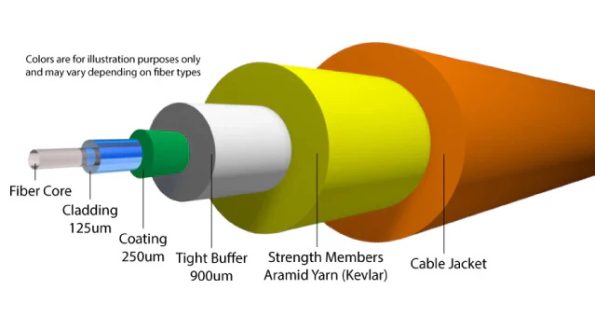
| Layer | Typical Material | Refractive Index | Primary Function |
| Core | SiO₂ + GeO₂ dopant | n₁ ≈ 1.468 (1550 nm) | Confines mode field, minimizes Rayleigh scattering |
| Cladding | Pure SiO₂ | n₂ ≈ 1.462 | Creates Δn ≥ 0.006 for TIR* |
| Coating | UV-cured acrylate | — | Adds 50–100 kpsi proof strength, blocks 0.38 ppm OH⁻ ingress |
*TIR = total internal reflection, critical angle θc ≈ 78°.
The result: attenuation < 0.17 dB km⁻¹ at 1550 nm, equivalent to losing only 4 % of photons after 20 km—orders of magnitude better than the 10 dB km⁻¹ of 1960s fiber.
2. Single-Mode vs. Multimode—Distance vs. Density
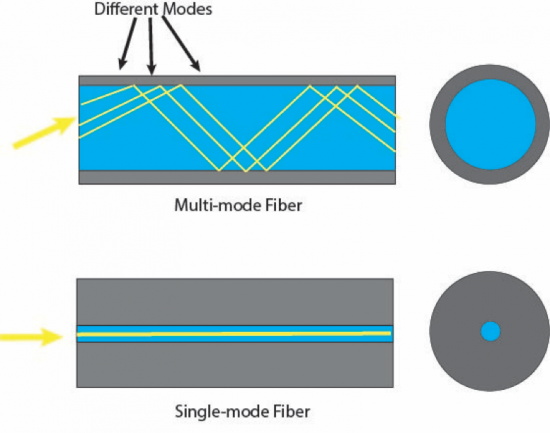
| Metric | G.652.D Single-Mode | OM4 Multimode |
| Core Ø | 8.2 µm | 50 µm |
| Modal BW | — | 4.7 GHz·km EMB* |
| Reach @ 100 Gb/s | 40 km (4λ CWDM) | 150 m (SWDM4) |
| Power Budget | 24 dB (PON) | 2.3 dB (BER 10⁻¹²) |
*Effective Modal Bandwidth, measured with DMD (differential mode delay) sweep.
Rule of thumb: single-mode for metro/long-haul; multimode for < 300 m hyperscale “East-West” traffic where transceiver cost, not fiber cost, dominates CAPEX.
3. Specialty Fibers—When the Environment Fights Back
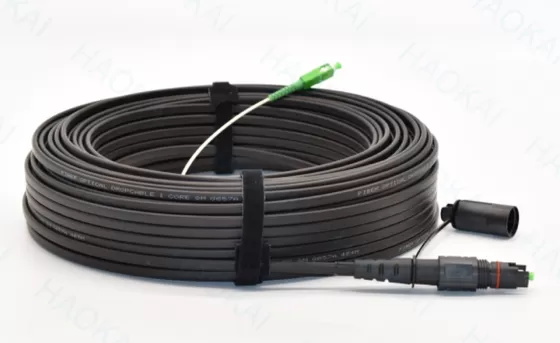
- Armored Loose-Tube: stainless-steel tape + PE inner + HDPE outer, crush 2000 N cm⁻¹, rodent-proof per IEC 60794-1-21 E04.
- Plenum OFNP: fluorinated polymer jacket, peak smoke density < 0.5 per ASTM E662, mandated in NFPA 70 air-handling spaces.
- IP68 FTTA: dual O-ring sealed bulkhead, 1 m submersion 168 h, salt-fog 1000 h per ASTM B117—5G macro-cell staple.
- Radiation-Hard Pure-Silica-Core: deployed at CERN, dose rate 1 MGy(Si) with < 5 dB km⁻¹ induced loss.
4. Connector Zoo—From SC to MPO-32
Insertion loss budgets shrink as lane rates explode. Modern hyperscale targets:
- LC/UPC duplex: 0.15 dB typ., 0.25 dB max.
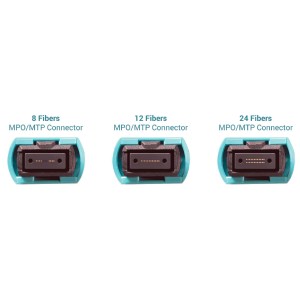
- MPO-24 APC (8-fiber rows): 0.35 dB single mated pair, ≤ 0.7 dB across 3-mated-pair channel—critical for 400GBASE-SR8.
Pro tip: polarity Method B (cross-over) eliminates the need for flip modules in duplex parallel optics, cutting link loss by 0.2 dB.
5. Beyond Glass—Coherent DSP & Hollow-Core Fiber
The 2023 industry inflection is not in glass chemistry but in how light is modulated. Latest 7 nm CMOS coherent DSPs (e.g., Infinera ICE-X) squeeze 800 Gb/s into a single λ using 128-QAM at 96 GBaud—yielding 6.4 b s⁻¹ Hz⁻¹ spectral efficiency.
Meanwhile, hollow-core fiber (HCF) from Lumenisity reduces latency by 31 % versus G.652 because group index ng ≈ 1.01. Microsoft just clocked 1.6 Tb/s through a 4.1 km HCF span—an early sign that trading firms will pay premium for every nanosecond saved.
6. Deployment Math—Why 5G & AI Clusters Are Fiber Hungry
A single 5G sector at 100 MHz TDD needs 25 Gb/s fronthaul; a three-sector site with three bands = 225 Gb/s—impossible without CPRI over DWDM.
Likewise, training GPT-4 required an estimated 3.2 × 10²³ FLOPs. Inside Meta’s 16,000-GPU RSC cluster, > 90 % of inter-GPU traffic rides on 400G SR4 multimode links—pushing connector cleanliness to “class 3000” cleanroom levels because a 1 µm particle induces 0.6 dB loss at 850 nm.
7. Future-Proof Checklist for Network Architects
- Choose bend-insensitive G.657.A1 for MDUs—10 mm bend radius shrinks cable pathways by 40 %.
- Standardize on APC connectors for any > 10 Gb/s PON—back-reflection < ‑55 dB prevents Raman crosstalk.
- Pre-terminated MPO trunk cables in data halls cut 70 % labor, but insist on IEC 61300-3-35 interferometry reports—radius of curvature < 5 mm guarantees long-term reliability.
- Budget for C-band only now, but pull 144-fiber count minimum; L-band (1565–1625 nm) will double capacity without new trenching.
Epilogue
Every click, swipe, and algorithmic heartbeat is a photon that surfed inside glass—quiet, invisible, yet rewriting geopolitics, finance, and culture. Understanding fiber optics is no longer a niche engineering topic; it is literacy for the decade when data becomes the world’s most traded commodity. Deploy it wisely, and you don’t just future-proof a network—you future-proof civilization’s next idea.