FREE shipping on orders over US$200
Executive Summary
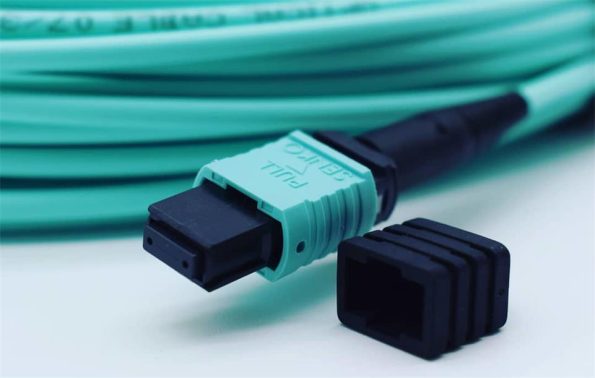
As digital transformation accelerates and data consumption reaches unprecedented levels, Multi-fiber Push-On (MPO) cables have emerged as the critical infrastructure component enabling tomorrow’s high-density, high-bandwidth networks. This comprehensive analysis explores how MPO technology addresses the exponential data growth challenges facing modern data centers, telecommunications facilities, and enterprise networks.
The Data Deluge: Why Traditional Infrastructure Falls Short

The convergence of 5G network densification, hyperscale cloud expansion, and artificial intelligence/machine learning workloads has created a perfect storm of data demand. Traditional duplex LC/SC fiber connections—designed for 1G and 10G networks—simply cannot accommodate the spatial and bandwidth requirements of modern 40G, 100G, 400G, and emerging 800G applications.
Key Statistics:
- Global data center traffic is projected to exceed 20 zettabytes annually by 2025
- AI workloads require 10-100x more bandwidth than traditional applications
- Space constraints in metropolitan data centers have increased real estate costs by 300% over the past decade
MPO technology represents the evolutionary leap necessary to bridge this capacity gap.
MPO Technology Deep Dive: Engineering Excellence
Core Innovation: The MT Ferrule Architecture
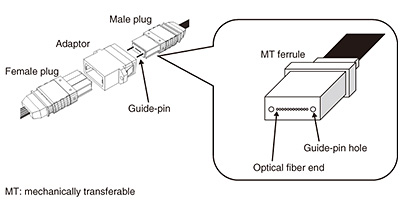
The MPO connector‘s revolutionary design centers on the precision-molded MT (Mechanically Transferable) ferrule, manufactured from high-performance thermoplastics such as polyphenylene sulfide (PPS) or polybutylene terephthalate (PBT). This component achieves sub-micron fiber alignment accuracy through:
- V-Groove Precision: Linear fiber positioning with ±0.5μm tolerance
- Guide Pin System: Stainless steel or ceramic alignment pins ensuring repeatable mating
- Advanced Polishing Techniques: APC (8° angled physical contact) and UPC (ultra-physical contact) finishes achieving <-65dB return loss
Technical Specifications Matrix
| Parameter | Single-Mode (OS2) | Multimode (OM4/OM5) |
|---|---|---|
| Insertion Loss | ≤0.35dB per mated pair | ≤0.25dB per mated pair |
| Return Loss | >65dB (APC) / >55dB (UPC) | >25dB |
| Mating Durability | ≥500 cycles | ≥500 cycles |
| Operating Temperature | -40°C to +75°C | -40°C to +75°C |
MPO Cable Taxonomy: Selecting Optimal Solutions
Fiber Count Configurations
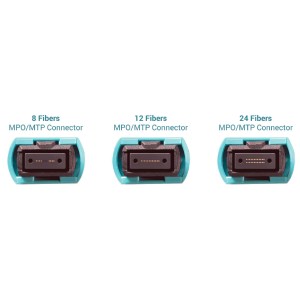
12-Fiber MPO: The industry workhorse
- Applications: 40G-SR4, 100G-SR4, 100G-PSM4
- Density advantage: 6x improvement over duplex LC
- Standard configuration: Single row, 250μm pitch
24-Fiber MPO: High-density backbone standard
- Applications: 400G-SR8, 100G-SR4.2 BiDi
- Configuration: Dual-row arrangement (A1-A12, B1-B12)
- Future-proofing: Supports 800G applications
48/72-Fiber Ultra-High Density: Next-generation solutions
- Technology: 200μm bend-insensitive fiber
- Applications: 1.6T aggregation, hyperscale core
- Innovation: Maintains standard MPO footprint through reduced pitch
Mode Selection Strategy
Single-Mode (OS2): Long-haul excellence
- Distance capability: Up to 10km for 100G-LR4
- Applications: Inter-data center connections, 5G fronthaul
- Cost consideration: Higher transceiver costs offset by unlimited bandwidth potential
Multimode (OM4/OM5): Economic efficiency
- OM4 reach: 100m @ 100G-SR4
- OM5 innovation: SWDM optimization enabling 440m reach
- Sweet spot: Intra-data center connections under 150m
Implementation Architecture: Building Scalable Infrastructure
Polarity Management: The Critical Success Factor
Understanding TIA-568.0-D polarity methods is essential for successful deployment:
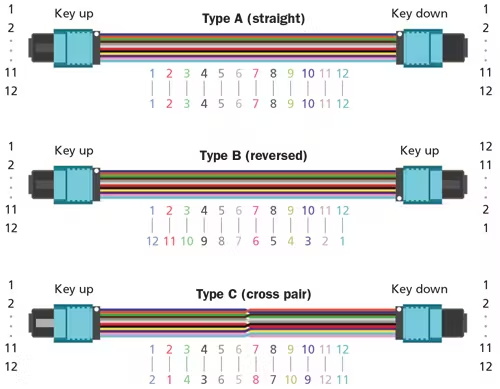
Method A (Straight-Through)
- Key-up to key-down configuration
- Applications: Direct parallel optic connections
- Risk: Requires careful key orientation management
Method B (Cross)
- Key-up to key-up standard
- Advantages: Simplified deployment, most common configuration
- Applications: Switch-to-switch connections
Method C (Cross Pair)
- Internal pair crossing
- Critical for: BiDi transceivers (100G-SR4.2, 400G-SR4.2)
- Complexity: Requires precise factory configuration
Deployment Architectures
Spine-Leaf Topology Optimization
- MPO-24 trunks between spine and leaf switches
- Benefits: 75% space reduction vs. duplex LC
- Scalability: Supports 400G upgrade path without recabling
Breakout Strategy
- MPO-to-LC cassettes for legacy equipment integration
- Ratio configurations: 1x12f MPO to 6x LC duplex
- Advantage: Seamless migration from 10G to 40/100G
Economic Analysis: Total Cost of Ownership
Capital Expenditure Analysis
| Component | Duplex LC | MPO-12 | Cost Advantage |
|---|---|---|---|
| Connector Cost | $2-3 | $8-12 | 4x higher |
| Cable Management | Extensive | Minimal | 60% reduction |
| Installation Time | 2 hours/connection | 15 minutes/connection | 87% faster |
| Space Requirements | 1U = 48 ports | 1U = 144 ports | 3x density |
Operational Expenditure Benefits
- Reduced Cooling Costs: 30% improvement in airflow efficiency
- Lower Power Consumption: Fewer switches required due to higher port density
- Decreased Maintenance: Factory-terminated connections eliminate field polishing
- Future-Proofing: Infrastructure supports 800G+ without replacement
Risk Mitigation: Ensuring Deployment Success
Critical Success Factors
- Contamination Control
- Implement MPO-specific cleaning protocols
- Use interferometer inspection for quality assurance
- Establish cleaning schedules for high-traffic connections
- Polarity Verification
- Deploy automated polarity testing equipment
- Create detailed documentation for each connection
- Train technicians on TIA-568.0-D standards
- Vendor Interoperability
- Source components from certified manufacturers
- Verify IEC-61754-7 compliance
- Conduct interoperability testing before deployment
Future-Proofing Strategies
Emerging Technologies Integration
- 800G pluggable optics compatibility
- Coherent optical systems support
- Silicon photonics integration readiness
Robotic Maintenance Preparation
- Design pathways for automated cleaning systems
- Implement smart monitoring capabilities
- Plan for AI-driven predictive maintenance
Conclusion: Strategic Infrastructure Investment
MPO fiber optic technology represents more than an incremental improvement—it constitutes a fundamental paradigm shift in network infrastructure design. Organizations implementing MPO solutions achieve:
- Immediate Benefits: 75% space reduction, 50% faster deployment
- Medium-term Advantages: Seamless 40G to 400G migration capability
- Long-term Value: Future-proofed infrastructure for 800G+ applications
As data growth continues its exponential trajectory, MPO technology provides the foundation for scalable, efficient, and cost-effective network infrastructure. The question is not whether to adopt MPO, but how quickly organizations can transition to remain competitive in an increasingly data-driven economy.
Next Steps: Organizations should conduct comprehensive infrastructure assessments, develop phased migration strategies, and partner with certified MPO solution providers Fiber-Life to ensure successful deployment of this critical technology.